Accolades for Sociology
A roundup of recent award-winning titles in sociology.
Congratulations are in order for our recent award-winning authors in sociology, whose books and honors are gathered below. Questions of national belonging, human rights, and the socialization of race are just a few topics addressed by these books—all of which were published within the last two years. These and other recent sociology titles are all currently 20% off when you order online using the conference discount code (S14SOC), and will also be available at the ASA conference in San Francisco this weekend.
on Asia and Asia America
by PAWAN DHINGRA
Indian Americans own about half of all the motels in the United States. Even more remarkable, most of these motel owners come from the same region in India and—although they are not all related—seventy percent of them share the surname of Patel. Most of these motel owners arrived in the United States with few resources and, broadly speaking, they are self-employed, self-sufficient immigrants who have become successful—they live the American dream.
Life Behind the Lobby explains Indian Americans' simultaneous accomplishments and marginalization and takes a close look at their own role in sustaining that duality.
by JO BECKER
Advocates within the human rights movement have had remarkable success establishing new international laws, securing concrete changes in human rights policies and practices, and transforming the terms of public debate. Yet too often, the strategies these advocates have employed are not broadly shared or known.
Campaigning for Justice addresses this gap to explain the "how" of the human rights movement. Written from a practitioner's perspective, and drawing on interviews with dozens of human rights advocates, this book explores the strategies behind some of the most innovative human rights campaigns of recent years.
by CATHERINE BLISS
In 2000, with the success of the Human Genome Project, scientists declared the death of race in biology and medicine. But within five years, many of these same scientists had reversed course and embarked upon a new hunt for the biological meaning of race.
Drawing on personal interviews and life stories, Race Decoded takes us into the world of elite genome scientists—including Francis Collins, director of the NIH; Craig Venter, the first person to create a synthetic genome; and Spencer Wells, National Geographic Society explorer-in-residence, among others—to show how and why they are formulating new ways of thinking about race.
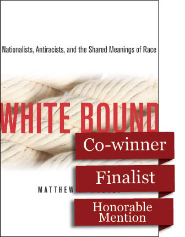
by MATTHEW W. HUGHEY
Matthew Hughey spent over a year attending the meetings, reading the literature, and interviewing members of two white organizations—a white nationalist group and a white antiracist group in order to investigate how white racial identity is construed by two seemingly antagonistic groups with differing worldviews, values, and ideological stances.
Though he found immediate political differences, he observed surprising similarities. Both groups make meaning of whiteness through a reliance on similar racist and reactionary stories and worldviews—an ironic and surprising tension that Hughey explores in White Bound. By examining the similarities and differences between seemingly antithetical white groups, we see not just the many ways of being white, but how these actors make meaning of whiteness in ways that collectively reproduce both white identity and, ultimately, white supremacy.

by KRISTIN SURAK
One of the most evocative symbols of Japan, the tea ceremony was originally a pastime of elite warriors in premodern society, it was later recast as an emblem of the modern Japanese state, only to be transformed again into its current incarnation: largely the hobby of middle-class housewives. How does the cultural practice of a few come to represent a nation as a whole?
Kristin Surak offers a comprehensive analysis of the practice, including new material on its historical changes, a detailed excavation of its institutional organization, and a careful examination of what she terms "nation-work"—the labor that connects the national meanings of a cultural practice and the actual enactment of it.
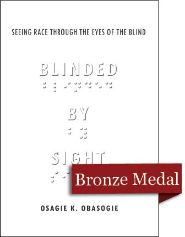
by OSAGIE K. OBASOGIE
Colorblindness has become an integral part of the national conversation on race in America. Given the assumptions behind this influential metaphor—that being blind to race will lead to racial equality—it's curious that, until now, we have not considered if or how the blind "see" race. Most sighted people assume that the answer is obvious: they don't, and thus, they perceive race differently—if at all.
In Blinded by Sight Osagie K. Obasogie, drawing on discussions with people from all walks of life who have been blind since birth, shows how even the blind aren't colorblind; blind people understand race visually, just like everyone else. Because blind people think about race visually, they orient their lives around these understandings in terms of who they are friends with, who they date, and much more.
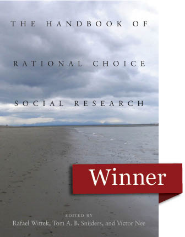
edited by RAFAEL WITTEK,
TOM A.B. SNIJDERS, & VICTOR NEE
Taking on issues ranging from financial markets and terrorism to immigration, race relations, and emotions, and a huge variety of other phenomena, rational choice proves a useful tool for theory-driven social research.
The Handbook of Rational Choice Social Research offers the first comprehensive overview of how the rational choice paradigm can inform empirical research within the social sciences. This landmark collection highlights successful empirical applications across a broad array of disciplines, including sociology, political science, economics, history, and psychology.
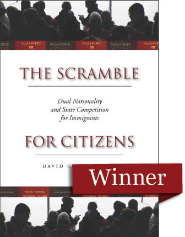
by DAVID COOK-MARTÍN
It is commonly assumed that there is an enduring link between individuals and their countries of citizenship. Plural citizenship is therefore viewed with skepticism, if not outright suspicion. But the effects of widespread global migration belie common assumptions, and the connection between individuals and the countries in which they live cannot always be so easily mapped.
In The Scramble for Citizens, David Cook-Martín analyzes immigration and nationality laws in Argentina, Italy, and Spain since the mid 19th century to reveal the contextual dynamics that have shaped the quality of legal and affective bonds between nation-states and citizens.
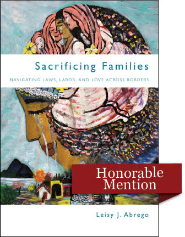
the Association for Humanist Sociology
by LEISY ABREGO
Widening global inequalities make it difficult for parents in developing nations to provide for their children, and parents often find that migration in search of higher wages is their only hope. Their dreams are straightforward: with more money, they can improve their children's lives. But the reality of their experiences is often harsh.
Sacrificing Families offers a look at Salvadoran transnational families, how the parents fare in the United States, and the experiences of the children back home. It captures the tragedy of these families' daily living arrangements, but also delves deeper into the structural context that creates and sustains patterns of inequality in their well-being.


