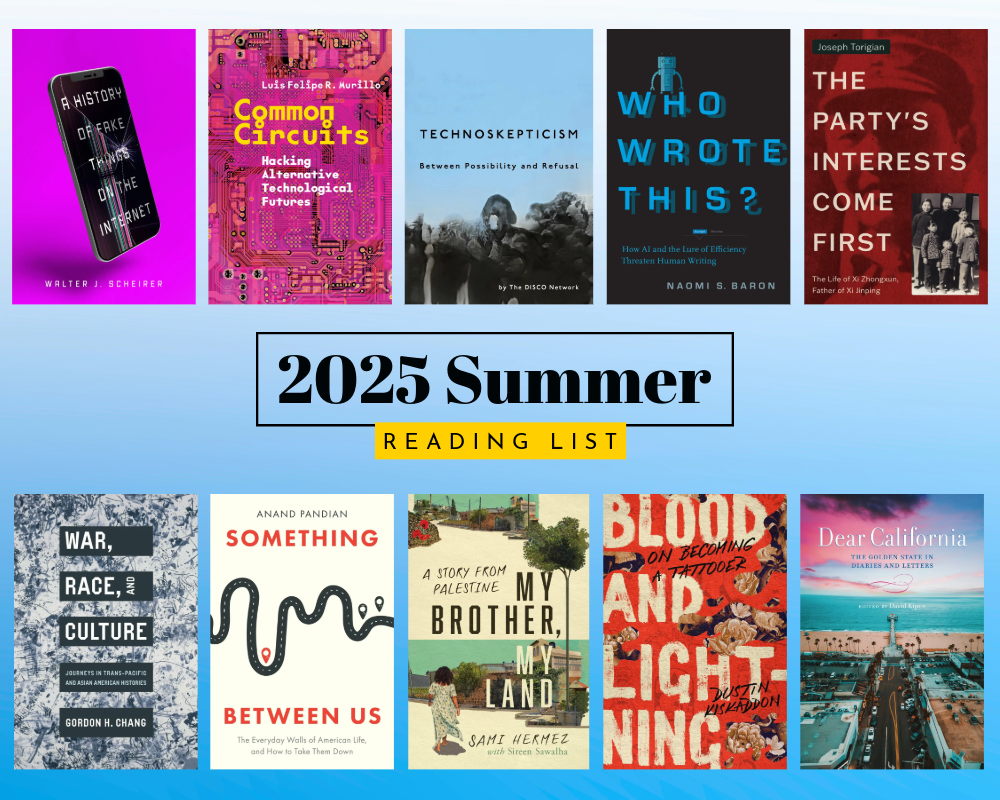
2025 Summer Reading Recommendations
This list is 100% not made by AI
A History of Fake Things on the Internet »
Walter J. Scheirer
A Next Big Idea Club “Must Read” for December 2023
As all aspects of our social and informational lives increasingly migrate online, the line between what is “real” and what is digitally fabricated grows ever thinner—and that fake content has undeniable real-world consequences. A History of Fake Things on the Internet takes the long view of how advances in technology brought us to the point where faked texts, images, and video content are nearly indistinguishable from what is authentic or true.
Computer scientist Walter J. Scheirer takes a deep dive into the origins of fake news, conspiracy theories, reports of the paranormal, and other deviations from reality that have become part of mainstream culture, from image manipulation in the nineteenth-century darkroom to the literary stylings of large language models like ChatGPT. Scheirer investigates the origins of Internet fakes, from early hoaxes that traversed the globe via Bulletin Board Systems (BBSs), USENET, and a new messaging technology called email, to today’s hyperrealistic, AI-generated Deepfakes. An expert in machine learning and recognition, Scheirer breaks down the technical advances that made new developments in digital deception possible, and shares behind-the-screens details of early Internet-era pranks that have become touchstones of hacker lore. His story introduces us to the visionaries and mischief-makers who first deployed digital fakery and continue to influence how digital manipulation works—and doesn’t—today: computer hackers, digital artists, media forensics specialists, and AI researchers. Ultimately, Scheirer argues that problems associated with fake content are not intrinsic properties of the content itself, but rather stem from human behavior, demonstrating our capacity for both creativity and destruction.
Common Circuits: Hacking Alternative Technological Futures »
Luis Felipe R. Murillo
How hackers facilitate community technology projects that counter the monoculture of “big tech” and point us to brighter, innovative horizons.
A digital world in relentless movement—from artificial intelligence to ubiquitous computing—has been captured and reinvented as a monoculture by Silicon Valley “big tech” and venture capital firms. Yet very little is discussed in the public sphere about existing alternatives. Based on long-term field research across San Francisco, Tokyo, and Shenzhen, Common Circuits explores a transnational network of hacker spaces that stand as potent, but often invisible, alternatives to the dominant technology industry. In what ways have hackers challenged corporate projects of digital development? How do hacker collectives prefigure more just technological futures through community projects? Luis Felipe R. Murillo responds to these urgent questions with an analysis of the hard challenges of collaborative, autonomous community-making through technical objects conceived by hackers as convivial, shared technologies.
Through rich explorations of hacker space histories and biographical sketches of hackers who participate in them, Murillo describes the social and technical conditions that allowed for the creation of community projects such as anonymity and privacy networks to counter mass surveillance; community-made monitoring devices to measure radioactive contamination; and small-scale open hardware fabrication for the purposes of technological autonomy. Murillo shows how hacker collectives point us toward brighter technological futures—a renewal of the “digital commons”—where computing projects are constantly being repurposed for the common good.
Technoskepticism: Between Possibility and Refusal »
The DISCO Network
From Munchausen by Tiktok to wellness apps to online communities to AI, the DISCO Network explores the possibilities that technoskepticism can create.
This is a book about possibility and refusal in relation to new technologies. Though refusal is an especially powerful mode—particularly for those who have historically not been given the option to say no—people of color and disabled people have long navigated the space between saying yes and saying no to the newest technologies. Technoskepticism relates some of these stories to reveal the possibilities skepticism can create.
The case for technoskepticism unfolds across three sections: the first focused on disability, the creative use of wellness apps, and the desire for diagnosis; the second on digital nostalgia and home for Black and Asian users who produced communities online before home pages gave way to profiles; and the third focused on the violence inherent in A.I.-generated Black bodies and the possibilities for Black style in the age of A.I. Acknowledging how the urge to refuse new technologies emerges from specific racialized histories, the authors also emphasize how care can look like an exuberant embrace of the new.
Who Wrote This? How AI and the Lure of Efficiency Threaten Human Writing »
Naomi S. Baron
New in Paperback!
Would you read this book if a computer wrote it? Would you even know? And why would it matter?
Today’s eerily impressive artificial intelligence writing tools present us with a crucial challenge: As writers, do we unthinkingly adopt AI’s time-saving advantages or do we stop to weigh what we gain and lose when heeding its siren call? To understand how AI is redefining what it means to write and think, linguist and educator Naomi S. Baron leads us on a journey connecting the dots between human literacy and today’s technology. From nineteenth-century lessons in composition, to mathematician Alan Turing’s work creating a machine for deciphering war-time messages, to contemporary engines like ChatGPT, Baron gives readers a spirited overview of the emergence of both literacy and AI, and a glimpse of their possible future. As the technology becomes increasingly sophisticated and fluent, it’s tempting to take the easy way out and let AI do the work for us. Baron cautions that such efficiency isn’t always in our interest. As AI plies us with suggestions or full-blown text, we risk losing not just our technical skills but the power of writing as a springboard for personal reflection and unique expression.
Funny, informed, and conversational, Who Wrote This? urges us as individuals and as communities to make conscious choices about the extent to which we collaborate with AI. The technology is here to stay. Baron shows us how to work with AI and how to spot where it risks diminishing the valuable cognitive and social benefits of being literate.
The Party’s Interests Come First:The Life of Xi Zhongxun, Father of Xi Jinping »
Joseph Torigian
China’s leader, Xi Jinping, is one of the most powerful individuals in the world—and one of the least understood. Much can be learned, however, about both Xi Jinping and the nature of the party he leads from the memory and legacy of his father, the revolutionary Xi Zhongxun (1913–2002). The elder Xi served the Chinese Communist Party (CCP) for more than seven decades. He worked at the right hand of prominent leaders Zhou Enlai and Hu Yaobang. He helped build the Communist base area that saved Mao Zedong in 1935, and he initiated the Special Economic Zones that launched China into the reform era after Mao’s death. He led the Party’s United Front efforts toward Tibetans, Uyghurs, and Taiwanese. And though in 1989 he initially sought to avoid violence, he ultimately supported the Party’s crackdown on the Tiananmen protesters.
The Party’s Interests Come First is the first biography of Xi Zhongxun written in English. This biography is at once a sweeping story of the Chinese revolution and the first several decades of the People’s Republic of China and a deeply personal story about making sense of one’s own identity within a larger political context. Drawing on an array of new documents, interviews, diaries, and periodicals, Joseph Torigian vividly tells the life story of Xi Zhongxun, a man who spent his entire life struggling to balance his own feelings with the Party’s demands. Through the eyes of Xi Jinping’s father, Torigian reveals the extraordinary organizational, ideological, and coercive power of the CCP—and the terrible cost in human suffering that comes with it.
War, Race, and Culture: Journeys in Trans-Pacific and Asian American Histories »
Gordon H. Chang
Writing history, the systematic effort to understand the human past, is a demanding intellectual endeavor. For historian Gordon H. Chang, it has also been a personal and moral enterprise intimately connected to his commitment to realizing a better world. This career-spanning anthology brings together significant essays, developing conversations across his broad-ranging research interests and personal history and engaging a range of topics, from diplomatic history and Asian American history to art history.
The book begins with a preface that reflects on the rise of Asian American studies as a field and the author’s own scholarly trajectory. Each essay is accompanied by new headnotes that provide context. Essays examine the many ways that race, especially regarding Asian Americans, connects important historical episodes and social issues. Themes of geopolitical conflict, race, and transnational methods link writing produced over several decades, illustrating the arc of an intellectual career and the development of the field of Asian American studies. Ultimately, this book highlights Chang’s abiding interest in providing historical context for issues facing Asian Americans, particularly during a time of rising geopolitical tensions and anti-Asian violence.
Something Between Us: The Everyday Walls of American Life, and How to Take Them Down »
Anand Pandian
An anthropologist’s quest to understand the deep social and political divides in American society, and the everyday strategies that can overcome them.
In 2016, Anand Pandian was alarmed by Donald Trump’s harsh attacks on immigrants to the United States, the appeal of that politics of anger and fear. In the years that followed, he crisscrossed the country—from Fargo, North Dakota to Denton, Texas, from southern California to upstate New York—seeking out fellow Americans with markedly different social and political commitments, trying to understand the forces that have hardened our suspicions of others. The result is Something Between Us: The Everyday Walls of American Life, and How to Take Them Down, a groundbreaking and ultimately hopeful exploration of the ruptures in our social fabric, and courageous efforts to rebuild a collective life beyond them.
The stakes of disconnection have never been higher. From the plight of migrants and refugees to the climate crisis and the recent pandemic, so much turns on the care and concern we can muster for lives and circumstances beyond our own. But as Pandian discovers, such empathy is often thwarted by the infrastructure of everyday American life: fortified homes and neighborhoods, bulked-up cars and trucks, visions of the body as an armored fortress, and media that shut out contrary views. Home and road, body and mind: these interlocking walls sharpen the divide between insiders and outsiders, making it difficult to take unfamiliar people and perspectives seriously, to acknowledge the needs of others and relate to their struggles.
Through vivid encounters with Americans of many kinds—including salesmen, truck drivers, police officers, urban planners, and activists for women’s rights and environmental justice—Pandian shares tools to think beyond the twists and turns of our bracing present. While our impasses draw from deep American histories of isolation and segregation, he reveals how strategies of mutual aid and communal caretaking can help to surface more radical visions for a life in common with others, ways of meeting strangers in this land as potential kin.
My Brother, My Land: A Story from Palestine »
Sami Hermez, with Sireen Sawalha
New in paperback!
A riveting and unapologetic account of Palestinian resistance, the story of one family’s care for their land, and a reflection on love and heartache while living under military occupation.
In 1967, Sireen Sawalha’s mother, with her young children, walked back to Palestine against the traffic of exile. My Brother, My Land is the story of Sireen’s family in the decades that followed and their lives in the Palestinian village of Kufr Ra’i. From Sireen’s early life growing up in the shadow of the ’67 War and her family’s work as farmers caring for their land, to the involvement of her brother Iyad in armed resistance in the First and Second Intifada, Sami Hermez, with Sireen Sawalha, crafts a rich story of intertwining voices, mixing genres of oral history, memoir, and creative nonfiction.
Through the lives of the Sawalha family, and the story of Iyad’s involvement with the Palestinian Islamic Jihad, Hermez confronts readers with the politics and complexities of armed resistance and the ethical tensions and contradictions that arise, as well as with the dispossession and suffocation of people living under occupation and their ordinary lives in such times. Whether this story leaves readers discomforted, angry, or empowered, they will certainly emerge with a deeper understanding of the Palestinian predicament.
Blood and Lightning: On Becoming a Tattooer »
Dustin Kiskaddon
New in Paperback!
Any tattoo is the outcome of an intimate, often hidden process. The people, bodies, and money that make tattooing what it is blend together and form a heady cocktail, something described by Matt, the owner of Oakland’s Premium Tattoo, as “blood and lightning.” Faced with the client’s anticipation of pain and excitement, the tattooer must carefully perform calm authority to obscure a world of preparation and vigilance. “Blood and lightning, my dude”—the mysterious and intoxicating effect of tattooing done right.
Dustin Kiskaddon draws on his own apprenticeship with Matt and takes us behind the scenes into the complex world of professional tattooers. We join people who must routinely manage a messy and carnal type of work. Blood and Lightning brings us through the tattoo shop, where the smell of sterilizing agents, the hum of machines, and the sound of music spill out onto the back patio. It is here that Matt, along with his comrades, reviews the day’s wins, bemoans its losses, and prepares for the future.
Having tattooed more than five hundred people, Kiskaddon is able to freshly articulate the physical, mental, emotional, and moral life of tattooers. His captivating account explores the challenges they face on the job, including the crushing fear of making mistakes on someone else’s body, the role of masculinity in evolving tattoo worlds, appropriate and inappropriate intimacy, and the task of navigating conversations about color and race.
Ultimately, the stories in this book teach us about the roles our bodies play in the social world. Both mediums and objects of art, our bodies are purveyors of sociocultural significance, sites of capitalist negotiation, and vivid encapsulations of the human condition. Kiskaddon guides us through a strangely familiar world, inviting each of us to become a tattooer along the way.
Dear California: The Golden State in Diaries and Letters »
Edited by David Kipen
New in Paperback!
Dispatches from a land of extremes, by writers and movie stars, natives and visitors, activists and pioneers, and more.
California has always been, literally, a place to write home about. Renowned figures and iconoclasts; politicians, actors, and artists; the world-famous and the not-so-much—all have contributed their voices to the patchwork of the state. With this book, cultural historian and California scholar David Kipen reveals this long-storied place through its diaries and letters, and gives readers a highly anticipated follow up to his book Dear Los Angeles.
Running from January 1 through December 31, leaping across decades and centuries, Dear California reflects on the state’s shifting landscapes and the notion of place. Entries talk across the centuries, from indigenous stories told before the Spanish arrived on the Pacific coast through to present-day tweets, blogs, and other ephemera. The collected voices show how far we’ve wandered—and how far we still have to go in chasing the elusive California dream.
This is a book for readers who love California—and for anyone who simply treasures flavorful writing. Weaving together the personal, the insightful, the impressionistic, the lewd, and the hysterically funny, Dear Californiapresents collected writings essential to understanding the diversity, antagonisms, and abiding promise of the Golden State.
Writings from Edward Abbey, Louis Armstrong, Ambrose Bierce, Octavia Butler, John Cage, Willa Cather, Cesar Chavez, Julia Child, Winston Churchill, Simone de Beauvoir, Albert Einstein, F. Scott Fitzgerald, Jane Fonda, Allen Ginsberg, Dolores Huerta, Langston Hughes, Zora Neale Hurston, Steve Jobs, Billy Joel, Frida Kahlo, John F. Kennedy, Anne Lamott, John Lennon, Groucho Marx, Henri Matisse, Marshall McLuhan, Herman Melville, Charles Mingus, Marilyn Monroe, John Muir, Ronald Reagan, Sally Ride, Joan Rivers, Susan Sontag, Mark Twain, Oscar Wilde, Laura Ingalls Wilder, Mark Zuckerberg, and many others.


Do you have any benefit from these referrals?