“Wrong Time, Wrong Place”
The clarion call of two men wrongfully detained in Guantanamo.
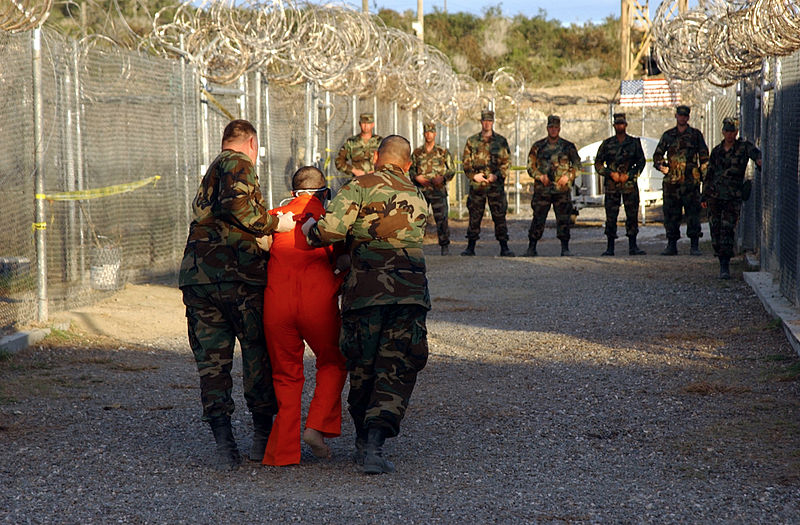
Attorney General Jeff Sessions recently described the military prison at Guantanamo as a “very fine place.” I’d like to introduce him to two men who know better: Lakhdar Boumediene and Mustafa Ait Idir, who spent seven years in Guantanamo before establishing their innocence.
Lakhdar and Mustafa were living quiet, peaceful lives in Sarajevo when, in October 2001, they were arrested by Bosnian police and accused of participating in a terrorist plot. After a three-month investigation uncovered no evidence, all charges were dropped. However, instead of releasing them, Bosnian officials—acting under the cover of darkness and intense U.S. pressure—handed them over to American soldiers who brought them, blindfolded and shackled, to Guantanamo.
Lakhdar and Mustafa were living quiet, peaceful lives in Sarajevo when, in October 2001, they were arrested by Bosnian police and accused of participating in a terrorist plot.
By 2002, military intelligence officers realized that the charges against Lakhdar and Mustafa were—as acknowledged in emails that surfaced years later—“bullshit.” Nevertheless, it took six-and-a-half years and a landmark Supreme Court ruling, Boumediene v. Bush, for Lakhdar and Mustafa to even have a chance to appear before a federal judge and argue their innocence. When they finally did, that judge, George W. Bush–appointee Richard Leon, was stunned by the weakness of the government’s case and ordered their release.
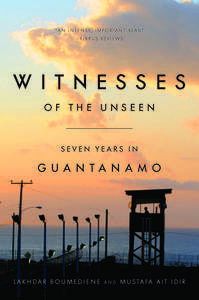
Now free men, Lakhdar and Mustafa have shared their story in a recently published book, Witnesses of the Unseen: Seven Years in Guantanamo. Remarkably, their story is one of hope, not hate. They believe that most Americans are good people who would have objected to their mistreatment if only we had taken the time to learn more about it. In their view, education, not violence, is the path forward. Their book offers a powerful rebuke to the notion, propagated by voices ranging from the Trump Administration to the so-called Islamic State, that there is an unbridgeable chasm between Islam and the West.
In the course of helping Lakhdar and Mustafa bring their story to print, I interviewed the U.S. intelligence officer who had first recommended that they be brought in for questioning, because a casual acquaintance of theirs had raised red flags. He told me that he was shocked to discover, years later, that Lakhdar and Mustafa had been brought to Guantanamo based on nothing more than his initial recommendation to question them.
“We didn’t have intelligence on these guys,” he told us. “This was a wrong time, wrong place kind of thing.”
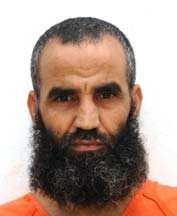
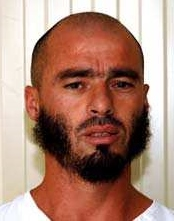
The penalty for being in the wrong place at the wrong time was years of abuse in a prison outside the reach of the law. At first, Lakhdar and Mustafa were housed in scorpion-infested cages under a relentless sun, sleeping next to buckets that served as their only bathroom, while the prison was literally being built around them. They then underwent interrogations that ended in beatings because they refused to confess to crimes they had not committed, or testify against men they did not know. They suffered from systematic sleep deprivation, threats of sodomy, assaults on their religion, and the fear, provoked by interrogators, that they would never see their families again.
“We didn’t have intelligence on these guys. This was a wrong time, wrong place kind of thing.”
While I never supported Guantanamo, I also never stopped to think about certain cruelties before Lakhdar and Mustafa recounted them. I had never tried to imagine what it would be like to try to sit perfectly still, chained to the floor of a plane, for some thirty hours without a bathroom break; or how much I would itch after being kept awake, unshowered and unshaven, for two straight weeks; or how frightening it would be to receive medical “care” from people who were actually trying to hurt me; or how tempting it would be to tell an interrogator anything he wanted, anything at all, to get him to stop withholding letters from my wife and children; or how wrenching it would be to know that my ten-year-old son was being teased by his classmates about the fact that his father was in Guantanamo.
It is of course impossible to fully imagine what any of those nightmares would actually be like to live through. But the inevitable failure of our imagination does not, and cannot, excuse the failure to at least pay attention. We owe it to Lakhdar and Mustafa, and men like them, to stop ignoring what they went through. We owe them an apology and reparations. At the very least, we owe it to them to stop describing Guantanamo as “a very fine place” or, to quote a recently circulated draft executive order, “humane”—a description that reveals a profound misunderstanding either of Guantanamo or of what it means to be humane.
In fact, if we truly want to shape public opinion in the Muslim world and undermine the appeal of extremists, we should close Guantanamo. Maintaining one of the most powerful recruitment tools for the so-called Islamic State is not, as President Trump has argued, “fighting fire with fire,” but fighting fire with gasoline. Rather than doubling down on a flawed institution that represents the very worst of our great nation, let us instead dedicate ourselves to the difficult, vital work of making America humane again.
Learn more and read an excerpt at WitnessesBook.com »


