Virtual Event for Stanford’s Middle East Series
A look at SUP’s Middle Eastern and Islamic Societies and Culture series
Last week, Stanford University Press hosted a virtual event about our Stanford Studies in Middle Eastern and Islamic Societies and Culture series ».
This event featured series editors Joel Beinin and Laleh Khalili leading a wide-ranging conversation on the current state of the field as well as Stanford University Press’s own contributions. Fellow panelists include series authors Darryl Li (The Universal Enemy) and Nahid Siamdoust (Soundtrack of the Revolution). Kate Wahl—SUP’s Publishing Director, Editor-in-Chief, and acquisition’s editor for the Middle East Studies list—hosted.
The Stanford Studies in Middle Eastern and Islamic Societies and Cultures explores the social and political conditions that enable various forms of cultural expression in the Middle East—whether Islamic, nationalist, or secular—and the ways in which these forms legitimate regimes and operate as social movements. Books in this series are particularly concerned with the relationships between the new international economy, local states, national and sub-national communities, and local, regional, and transnational forms of culture. With a chronological focus from World War II to the present, this series produces books of cutting-edge scholarship and broad appeal that address the region spanning from Morocco to Pakistan—the zone that constitutes the historic core of the Muslim-majority world.
Highlights from the series
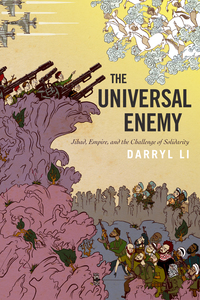
No contemporary figure is more demonized than the Islamist foreign fighter who wages jihad around the world. Spreading violence, disregarding national borders, and rejecting secular norms, so-called jihadists seem opposed to universalism itself. In a radical departure from conventional wisdom on the topic, The Universal Enemy argues that transnational jihadists are engaged in their own form of universalism: these fighters struggle to realize an Islamist vision directed at all of humanity, transcending racial and cultural difference.
Anthropologist and attorney Darryl Li reconceptualizes jihad as armed transnational solidarity under conditions of American empire, revisiting a pivotal moment after the Cold War when ethnic cleansing in the Balkans dominated global headlines. Muslim volunteers came from distant lands to fight in Bosnia-Herzegovina alongside their co-religionists, offering themselves as an alternative to the US-led international community. Li highlights the parallels and overlaps between transnational jihads and other universalisms such as the War on Terror, United Nations peacekeeping, and socialist Non-Alignment. Developed from more than a decade of research with former fighters in a half-dozen countries, The Universal Enemy explores the relationship between jihad and American empire to shed critical light on both.
Learn more about Stanford’s Middle Eastern and Islamic Societies and Culture series »


