Crowdsourcing American History
A free, open, online history textbook offers a democratic alternative to the American past.
Exploding costs plague higher education, and textbooks are at the center of this crisis. Over the past forty years, textbook prices have jumped fifteen-fold—three times the rate of inflation, and the College Board has found that the typical student now spends $1,200 every year on textbooks and supplies. Community colleges and other educational institutions catering to nontraditional or first-generation college students still rely heavily on traditional textbooks, which means that the very students least able to afford these ever-increasing costs are the most likely to bear them. Moreover, many students forego buying their textbooks altogether— found that two-thirds of students reported not buying a book because of cost, and nearly all of those did so knowing that this would affect their grade. As our campuses ring with calls for authentic assessment, we are left to wonder how authentic our assessments can be if over sixty percent of our students determine that they cannot afford to earn an A.
Our goal was not simply to create a free textbook. We also wanted to collaborate to make a better textbook.
Enter The American Yawp, the first massively collaborative, open U.S. history textbook produced by scholars of American history. We conceived of the project while teaching at community colleges in the greater Houston area as graduate students at Rice University. Frustrated at the high costs and occasionally uneven quality of existing U.S. history textbooks, we were shocked to find that an open alternative didn’t yet exist. And so we went to work. Our project was designed to achieve two goals: the first was to address the soaring costs of textbooks by creating an open alternative; the second was to experiment with new collaborative methods to build a textbook that was not only cheaper, but better.
The American Yawp is a fully open resource: users are encouraged to use it, download it, distribute it, and modify it as they see fit. Formally licensed under a Creative Commons Attribution-Share Alike 4.0 International (CC-BY-SA) License, this project is designed to meet the standards of a "Free Cultural Work," and since its launch, it has become clear that the project is meeting a major demand. In just over three years, it has been accessed by almost one millions users, generating over six million pageviews. And the numbers continue to grow exponentially: more than two million pageviews from three hundred thousand unique users came in the fall of 2018 alone.
Since we launched the project, we have been pleased to see others take up the cause as well. Foundation-funded OpenStax, for instance, has launched an open U.S. history text, and the University of Chicago Press recently published a that is available free as an ebook.
But our goal was not simply to create a free textbook. We also wanted to collaborate to make a better textbook. We believe that American history is simply too big and too broad for one individual, or even a small team of editors, to master. We wanted to collaborate with the profession to capture the very best of current scholarship. Over three hundred historians answered the call, providing submissions to our first draft. In their contributions, these scholars responded to the straightforward but challenging question, “What do undergraduates absolutely need to know about your area of expertise?” A collaborative team of editors then winnowed these contributions into narratively coherent chapters. Since we went live in the fall of 2014, hundreds of other historians have offered paragraph-by-paragraph feedback through our open review platform, and this collaborative process continues.
Balancing academic rigor with popular readability, The American Yawp offers a multi-layered, democratic alternative to the American past.
The fruit of this ongoing, crowdsourced effort is The American Yawp, an accessible historical narrative constructed from all the best of recent historical scholarship. Without losing sight of politics and power, it incorporates transnational perspectives, integrates diverse voices, recovers narratives of resistance, and explores the complex process of cultural creation. It looks for America in crowded slave cabins, bustling markets, congested tenements, and marbled halls. It navigates maternity wards, prisons, streets, bars, and boardrooms. The multiplicity of its perspectives is rooted in the conviction that American history cuts across the narrow boundaries that have strangled many other narratives. Balancing academic rigor with popular readability, The American Yawp offers a multi-layered, democratic alternative to the American past.
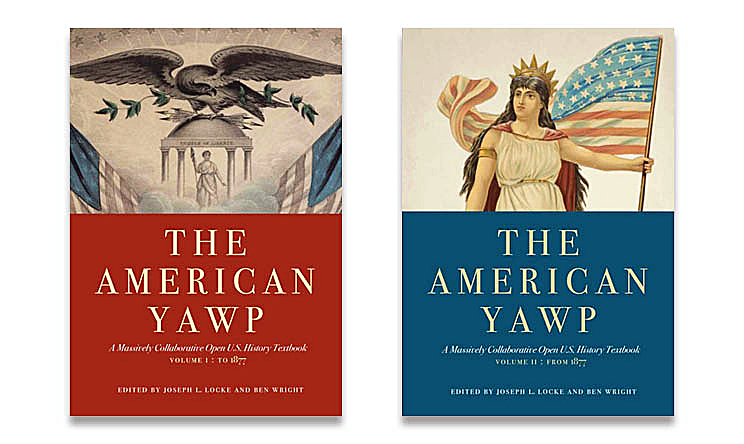
And still, for many, the question of quality remains. How can a digital text ensure instructors and readers of its quality? In addition to the massively collaborative process of putting this project together and soliciting feedback through an ongoing open review process, we sought to also apply the traditional high standards of our discipline: formal peer review. From 2016 to 2017, the manuscript underwent Stanford University Press’s standard peer review process, and was formally accepted by the Press’s Editorial Board. The valuable feedback we received has informed a current redrafting that will be reflected in the forthcoming Stanford University Press edition of The American Yawp, which will remain an open and free online resource, with a two-volume print edition to debut next spring. SUP, already an innovative publisher of the digital humanities, offered the traditional resources of a university press while acting as an innovative partner willing to experiment with creative forms of digital publication.
As we move forward with our new partners, we look to our project’s patron saint, Walt Whitman—from whose famous poem we borrowed the titular “yawp”—for continued inspiration: When it comes to new models of research, writing, and publication, we urge the American historical profession to, as Whitman put it in 1855, “re-examine all you have been told.”


