A Crisis Older Than Climate Change
The Deeper History of Iraq’s Environmental Crisis
Dale J. Stahl
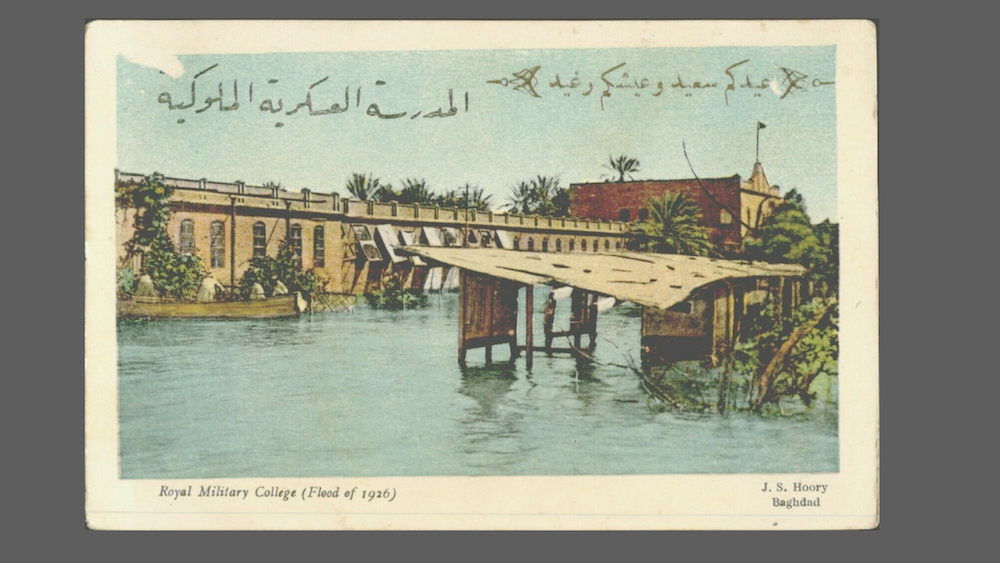
Postcard by J.S. Hoory, Baghdad (1926). Public Domain, via Wikimedia Commons. Gray background added by SUP staff.
Iraq’s current environmental crisis is often told as a story of rising temperatures, population growth, drought and desertification. The villains are contemporary: climate change, Turkey’s ongoing dam-building spree, and the depredations of corruption and Islamic State fighters. But Iraq’s ecological vulnerabilities were written into the country’s landscape much earlier—decades before the first big dams on the Euphrates—through twentieth-century efforts to remake the rivers into instruments of order, productivity, and state power.
In early twentieth-century Mesopotamia, the problem wasn’t too little water. It was too much. Iraq’s great rivers used to flood on a biblical scale. One of the first engineers to consider flood control plans along the Tigris and Euphrates, William Willcocks, warned his fellows to be mindful, for Iraq was the location of “Noah’s flood in the early days of the World’s history.” Iraq’s big rivers gave the country’s planners and politicians big hopes: a robust, year-round agriculture protected from spring floods and sustained through the summer by comprehensive irrigation. Willcocks’s survey, commissioned by the Ottoman government, became a template for engineers during the British occupation of Iraq after the First World War.
For years, that’s all there was: big hopes. The British fought first among themselves over what the rivers should be: navigable waterways for trade, or water sources for agriculture. Then, they fought with Iraqis over what Iraq should be: an imperial possession or a country governed by its own people. Then, after months of violent suppression, the British decided they wanted to rule Iraq on the cheap. Instead of a new Egypt, a Fertile Crescent granary for the Gulf and India, Iraq became valuable to Britain mainly for its strategic position and was governed through a pliant monarchy bound by treaty to serve British interests.
Those interests meant trading Iraq’s water and land for political control. During the 1920s and 1930s, a narrow elite gained control over an ever larger share of the country’s agricultural land. Under mandate-era law, a diesel-powered water pump counted as an “improvement,” and improvement could become a claim to ownership. Landholders set up thousands of pumps along the rivers, extending cultivation and converting water into both land and political influence. This landed elite, represented in Iraq’s parliament, became one of the three instruments of British power—the air force and the monarchy were the other two.
This system, however, faced a problem: how to sustain order through Iraq’s water and land. First, there were the floods. The 1926 flood wrecked the Iraqi king’s lands and swamped his palace; huge floods continued into the 1940s and 1950s. But these could be tamed by building Willcocks’s reservoirs using funds from Iraq’s other great resource: petroleum. Unfortunately, oil was not the only thing underground: there was also a great deal of salt. These rose together: oil made it possible to build giant reservoirs, giant reservoirs made it possible to irrigate, irrigation made salinization inevitable. By the early 1950s, more than a third of Iraq’s agricultural lands had become salinized. Worse still, the vaunted flood-control reservoirs were planned for basins already saturated with salt. The Euphrates’ floodwaters were literally dumped into a depression known as the “Sea of Salt” (it’s now known as Lake ar-Razzaza). To offset the basin’s salinity, another British engineer, Frank Fraser Haigh, outlined for the first time the modern sacrifice of Iraq’s marshes, in this case for a drain to empty salinized water into the Persian Gulf.
This was when the promise of control—those big hopes—ran up against ecological reality. A corrupt political class, eager to draw up the oil to build Iraq’s future, burned both carbon and cash to construct a water system destined to salinize both land and water. This water system, designed for flood control and irrigation, consigned Iraq’s southern marshes to drainage and thus to a socio-ecological disaster. And the connections between oil, water, and salt, forged in the mid-twentieth century to extend imperial authority, have only grown more tenacious and destructive over time. Lake ar-Razzaza is drying up, returning to its original form. The water in Iraq’s other large reservoir, Wadi ath-Tharthar, is too saline for irrigation use. The oil keeps flowing, and both salinity and temperatures keep rising.
So when we speak of Iraq’s environmental crisis, we often begin too late. Climate change, upstream dams, war, and corruption have all intensified the crisis. But these did not act on a blank landscape. Today’s pressures are so devastating because they are happening to a river system already remade to be less flexible, more saline, and more reliant on large-scale engineering to service human needs. That remaking was not Iraq’s alone. The brittle ecology of today’s Tigris and Euphrates was shaped by British imperial rule, by hydraulic visions that treated rivers as instruments of order, and by the voracious global demand for Iraqi oil.
Dale J. Stahl is Associate Professor of History at the University of Colorado Denver.


