Cherry Blossoms & Confederate Flags
On the power of symbols and their contested meanings.
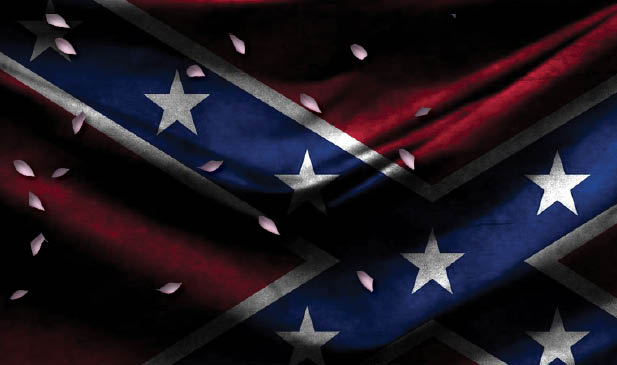
Symbols are important. They are ubiquitous, they are charged, and they are powerful. And yet, in ordinary circumstances rarely do we articulate in our own mind, let alone communicate with other members of our social group, which meaning we derive from a particular symbol in a given context. In ordinary times the cherry blossom in Japan signals positive meanings including the celebration of life, love, and reproductive energy—meanings that would change during the country’s military period. One of the flower’s symbolic meanings—pathos over the brevity of life—was transformed into a military dictum: “Thou shalt fall like beautiful cherry petals after a short life for the emperor-cum-Japan.” It became the Japanese state’s major trope of propaganda during its quest for imperial power, though few of the soldiers who were sent to the front were cognizant of this symbolic reassignment.
The Confederate flag controversy demonstrated in no uncertain terms how dramatic expressions of symbolic power do not happen in a vacuum.
The important dynamics of symbols came to the fore in a most dramatic way when the mass killings at a black church in Charleston, South Carolina, triggered an intense public debate over what the Confederate flag stood for. Dylann Roof, the young white man who espoused white supremacist views, went on a rampage, shooting and killing nine people—all African American—during a Bible study meeting this past June. It took place in a historically important black church—the Emanuel A.M.E. Church, which survived antebellum laws barring worship by blacks, an angry white mob that burned down its original edifice, and the execution of its founder and dozens of others condemned for planning a slave revolt.
“Suddenly” it was revealed in bright daylight, as it were, how many different meanings had been assigned to the same flag by different social groups and different individuals in different historical contexts. The flag was—and is, for many still—the identity incarnate of the Confederate South. In different historical times, elements of the flag were added to the state flags of a handful of Southern states, including Florida, Alabama, and Mississippi. Georgia added them in 1956, while South Carolina began hoisting the flag over the state house as recently as 1961, before Governor Nikki Haley had the flag ceremoniously removed following the Charleston massacre. Some acknowledge—and even embrace—its white supremacist undertones, but for many others it has simply come to represent southern culture and heritage. For this latter group the flag may symbolize the patriotism of their ancestors who fought in the Civil War, or the importance of States’ Rights, or the cultural traditions of the region, from sweet tea to bayous.
For many other Americans, however, it represents the dark past of slavery and the racism that continues to oppress African Americans. The banner has frequently accompanied Southern resistance to racial equality, from the slaveholding rebel south of the 1860s, to the segregationist Dixiecrats who barricaded black youth out of school classrooms little less than a century later. These racial disparities continue to exist as exemplified in the disproportionate number of police killing of unarmed black men. Ferguson’s Michael Brown has many parallels—not only in New York, San Diego and Las Vegas, but in Madison, Wisconsin, a traditionally liberal “quiet university town.”
On the other hand, at present, the President of the United States and the attorney general are both African American, and the governor of South Carolina, who ordered the Confederate flag to be removed from the state house grounds, is a minority woman, the daughter of Indian immigrants. At the time when we witness dramatic changes in the American political, social and cultural scenes, the Confederate flag incident brought forth a tug-of-war between two drastically opposed views about race. Consequently, the flag came to be seen to represent the division, rather than the unity, of the people of the United States.

The Confederate flag controversy demonstrated in no uncertain terms how dramatic expressions of symbolic power do not happen in a vacuum. They take place in vertigos of historical currents. That is, symbols are not decorations without substance, nor are they confined to a ritual.
If the flag, with its multiple and changing meanings, generated a strong symbolic power, the act of taking down the flag, creating the absence of the flag, became an even more powerful symbol. As described in the statement by President Barack Obama, taking down the Confederate flag was a “signal of good will and healing, and a meaningful step towards a better future.” The absence of the symbol, therefore, became a symbol in and of itself—what I call a “zero-signifier”, a symbol without material presentation that is still symbolically charged.
What the controversy swirling around the Confederate flag reveals is that it is imperative to closely examine how symbols work—their relational and processual meanings as well as the roles that the aesthetic plays in this process—and how these characteristics create what I call “communicative opacity.” The focus on symbols in political spaces helps us understand how divergent views on a symbol’s significance or the obscuring of its historical or newly-created meaning, can be misleading and facilitate the translation of cultural identity, including idealistic patriotism, into a potentially more macabre, politicized nationalism—a process that can encourage people to cooperate in wrongheaded causes.
Start reading Flowers That Kill »
 Emiko Ohnuki-Tierney is the William F. Vilas Professor of Anthropology at the University of Wisconsin. She is the author of several books, including Illness and Culture in Contemporary Japan (Cambridge University Press), Rice as Self: Japanese Identities Through Time (Princeton University Press), editor of Culture Through Time, contributor to Golden Arches East and author, most recently, of Flowers That Kill: Communicative Opacity in Political Spaces.


