Oklahoma’s Botched Execution: A Game-Changer?
Debate over the death penalty has been reignited by a failed lethal injection.
On Tuesday Clayton Lockett became the latest case in a long litany of botched executions to muddy America’s capital punishment record. European drug manufacturers, reluctant to associate their pharmaceuticals with the death penalty, have cut American prisons off from lethal drugs like pentobarbital and sodium thiopental, which has left prison officials scrounging for substitutes. The 3-drug protocol Oklahoma used to execute Lockett this week was an entirely untested cocktail that produced ghastly results and incurred stern censure from President Obama’s top spokesman on Wednesday.
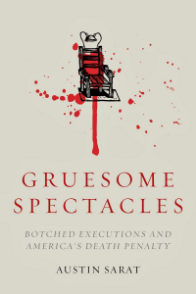
Lockett’s execution has since provoked a maelstrom of debate around the death penalty and its modes, effects, and moral implications. Austin Sarat, law professor and author of the timely book, Gruesome Spectacles: Botched Executions and America’s Death Penalty has been a go-to commentator for news outlets seeking insight on the Oklahoma execution and the death penalty more broadly. In the following 23-minute interview with Northern California’s NPR affiliate, Sarat is asked if Lockett’s botched execution is a game-changer for the death penalty debate—and he says it is.
The 8th Amendment prohibits cruel and unusual punishment, with the long-held judicial stance on the death penalty being that execution methods that effect the “mere extinguishment of life” without inflicting undue pain, satisfy this standard. Botched executions throw a wrench in this formula, however, as the effects of a state execution gone awry are often tantamount to torture for the condemned.
With each successive method of execution—electrocution, lethal gas, and now lethal injection—the advertised virtues have always been that each method was more humane than the one preceding it, owing to the rationale that improved technology yielded ever-quicker and ever-cleaner outcomes. But Sarat maintains that this romance with new technologies oftentimes obscures the truth. Lethal injection, for example, has the highest error rates of any death penalty mechanism since 1890—including the noose. On this, Sarat is unequivocal: lethal injection is “the worst method of execution since the 19th century.”
In the course of the conversation on Lockett and the death penalty, observers have often expressed ambivalence for the suffering of the condemned, pointing to the heinous nature of the crimes of death row inmates. On this front, Sarat is far from naïve. In an interview with the Chronicle of Higher Education he is asked:
Q:
[In your book] you make a point of describing crimes people committed (Mr. Lockett was convicted of shooting a teenager and watching as she was buried alive). Why did you do that?
A:
I think it’s really important in the conversation about executions to tell the story, to give a narrative that acknowledges both sides, to make the death penalty less of an abstraction. This was a real human being. This is what he did to other real human beings. This is what his life was like. We could have written a very different book, one that was much more academic. We wanted to produce a book that reached a wider audience and move the death penalty away from the abstractions toward an encounter of what really happens on the ground.
Sarat’s concerns have less to do with how wrongful or deserving of empathy the accused is, and more to do with what error-riddled death sentences say about our identity as a nation and our values as a people. Is it acceptable that executions should inflict physical pain and cruelty in 3-7% of all cases? Is it permissible to run the risk of violating constitutional, and some would even argue, human rights by keeping the death penalty on the table?
Sarat’s not so sure that those are attractive propositions for most Americans; “I think we’re on the road to abolition,” he says. “The question of the death penalty is no longer about those we execute; it’s about who we are.”
Don’t miss Sarat’s op-eds running today in
The Guardian and New Republic.
+
Catch Sarat on NPR’s All Things Considered tomorrow
+
Read “The Mere Extinguishment of Life?”—the first chapter
of Gruesome Spectacles.
+
And for more info check out these links:
- “What botched executions tell us about the death penalty” Boston Globe
- “Botched executions since 1900” Washington Post
- “Lethal Injection Is a Terrible Way To Kill People” Mother Jones
- “These Disturbing Truths Shed Light On The Cruelty Of The U.S. Death Penalty” Huffington Post
- “Gruesome Spectacles by Austin Sarat” The Rumpus
UPDATE:
- “In Evolution of Execution Methods, Botched Procedures Remain” All Things Considered (NPR)
- “Lethal Injection Is Pretty Much the Worst Way to Execute People. So Why Do We Use It? New York Magazine
- “The Horrifying Details of Clayton Lockett’s Torturous Execution in Oklahoma” New York Magazine
- “State-approved torture in Oklahoma” Chicago Tribune
- “John Paul Stevens is right: The death penalty is unconstitutional” The Week


